Mozambique
To improve PrEP uptake, Mozambique is implementing provider-initiated promotion in health facilities and peer-led outreach.
Background
Prevention of incident HIV infections among pregnant and breastfeeding women is one of the priority interventions for vertical transmission prevention in Mozambique. HIV prevention services have been integrated within the maternal and child health services at antenatal care clinics, child health clinics, and family planning clinics.
Pre-exposure prophylaxis (PrEP) in Mozambique is offered through a choice-based approach incorporating the available oral and injectable options. To improve PrEP uptake, Mozambique is implementing a comprehensive demand creation strategy that includes facility-based and community approaches. Facility-based demand generation is through provider-initiated PrEP promotion in health facilities, while community-based approaches leverage peer-led approaches, social media campaigns, and community outreach activities.
In 2025, 31% of all PrEP initiations in the country were among pregnant and breastfeeding women. To further strengthen uptake, Mozambique is seeking to increase PrEP services coverage beyond the current 61% of health facilities offering PrEP. In April 2026, the country introduced long-acting injectable lenacapavir to expand a range of options and improve pregnant and breastfeeding women’s choices.
Progress toward elimination targets, 2024
| Elimination of vertical transmission | |
|---|---|
| Pregnant women who received ART for VTP (#) | 110,000 |
| Pregnant women needing ART for VTP (#) | 130,000 |
| Coverage of pregnant women who received ART for VTP (%) | 82 |
| Early infant diagnosis < 2 months of age (%) | 68 |
| New HIV infection among children (#) | 16,000 |
| New HIV infections averted due to VTP interventions | 25,000* |
| Final vertical transmission rate including during breastfeeding (%) | 12.2 |
| Number of HIV-exposed children who are uninfected (Million) | 1,400,000 |
| Source: UNAIDS 2024 estimates, *UNAIDS 2024 country fact sheet 2023 | |
HIVE-Supported National PrEP Assessments
In April 2026, Mozambique conducted a national PrEP self-assessment to evaluate the implementation and monitoring of HIV testing services and PrEP services for pregnant and breastfeeding women. The assessment covered key areas, including HIV testing policies, PrEP guidelines, service delivery, PrEP eligibility and initiation, demand creation, monitoring and evaluation, and community monitoring. Overall, Mozambique demonstrated strong performance across most domains with well-established HIV testing policies, comprehensive PrEP guidance, PrEP service delivery systems, demand creation, and monitoring and evaluation. The assessment identified opportunities to strengthen implementation by synchronizing PrEP and MCH visits, engaging community health workers to support PrEP adherence, linking PrEP services and MCH services, and linking the electronic medical records with the District Health Information System. In addition, opportunities were identified to strengthen community monitoring by increasing use of community data to inform PrEP programming, expanding strategies to reach postpartum women who do not access routine MCH services, and increasing the involvement of community health workers and peers in promoting PrEP continuation. The figure below summarizes the results of the national PrEP assessment.
HIVE Engagement
Mozambique joined the HIVE network in October 2024. The partnership began with a baseline visit from the HIVE team, which engaged the Ministry of Health, UN agencies, PEPFAR partners, and implementing organizations. The Ministry nominated the national PMTCT coordinator to lead Mozambique’s engagement.
Since then, Mozambique has actively participated in HIVE learning exchanges and piloted HIVE’s Vertical Transmission Elimination Capability Maturity Model (VTE CMM). In December 2024, Mozambique conducted a self-assessment using the VTE CMM. The assessment identified the most mature and least mature domains, as shown in the figure below:
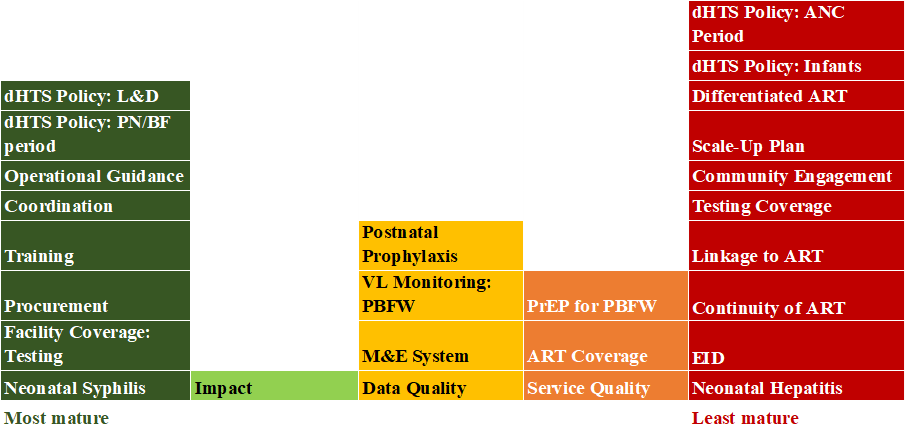
Overview of Mozambique’s 2024 VTP self-assessment results