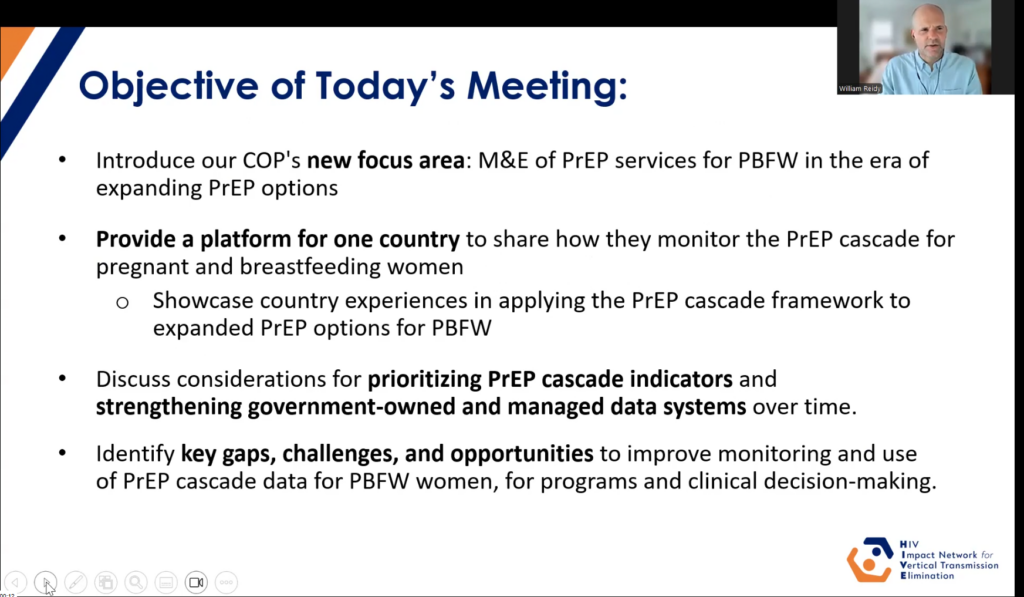
The HIVE M&E Community of Practice (CoP) held its second virtual meeting on February 26, 2026, bringing together country program representatives from the six HIVE-member countries, including vertical transmission prevention and M&E leads and ICAP and PATA technical staff. The meeting focused on how national data systems can account for new HIV prevention options for pregnant and breastfeeding women, including oral PrEP and the long-acting options now available to country programs.
“As oral PrEP scales up and long-acting options such as lenacapavir are introduced, countries need monitoring systems that reflect the full continuum of care, and support decision-making at the facility and programmatic levels,” said Bill Reidy, PhD, MPH, ICAP deputy director for Strategic Information, in framing remarks. “This community of practice will support countries in consolidating tools, strengthening facility-level monitoring, and ensuring that data is routinely used to improve programs and decision-making.”
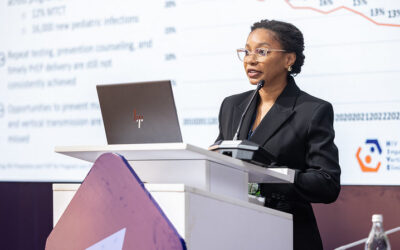
Karampreet Sachathep, PhD, ICAP senior strategic information manager and CoP lead, then shared results from a pre-meeting poll of meeting participants on the current state of PrEP M&E and the most pressing gaps for countries. While 75 percent of respondents said their national systems monitor PrEP use among pregnant and breastfeeding women, 51 percent could not separate the data for the two groups, and most were able to track PrEP initiation but not continuation. Asked where to focus next, 40 percent of respondents identified tracking continuation as the top priority, followed by capturing the pre-initiation phase –eligibility screening and enrollment – and disaggregating pregnant from breastfeeding women in routine reporting.
With maternal infections during pregnancy and breastfeeding driving nearly one-third of vertical transmissions in Eastern and Southern Africa, according to UNAIDS estimates, “our M&E focus must shift towards standardized monitoring of effective use of PrEP and continuation throughout the entire period of risk,” Sachathep said.
Mozambique provided an example that illustrated why tracking continuation matters. Orrin Tiberi, M&E lead at Mozambique’s National Program for STIs and HIV/AIDS, described how the country expanded PrEP eligibility to maximize enrollment, but deprioritized continuation monitoring in 2023. An electronic medical record analysis covering 2021 to 2024 found that of 480,000 people who initiated PrEP, only 30% of pregnant women had a documented two-month follow-up visit. The finding pointed to a gap that initiation data alone could not capture whether women remained on PrEP through the period of risk.
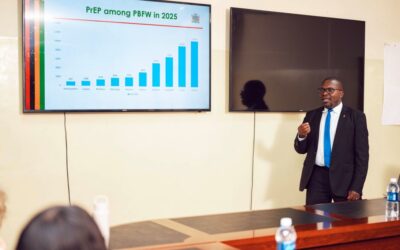
In a panel discussion following Tiberi’s presentation, Chimuka Sianyinda, strategic information officer at Zambia’s Ministry of Health, shared an example of how PrEP continuation is monitored in Zambia. The country’s DHIS2 Tracker–based system uses four longitudinal forms covering eligibility, clinical follow-up, discontinuation, and post-discontinuation. The system runs on infrastructure already used for COVID-19 vaccination. It supports both client-level tracking and aggregate reporting. As Zambia rolls out lenacapavir for pregnant and breastfeeding women, the system is already structured to monitor continuation across PrEP options.
During Q&A on country support needs, representatives from Tanzania and Nigeria shared priority areas for peer support, including longitudinal tracking across antenatal and postnatal platforms, disaggregation of pregnant from breastfeeding women, and client-level PrEP digitization ahead of Nigeria’s lenacapavir rollout.
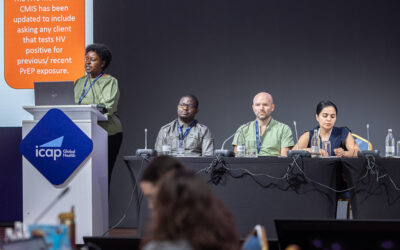
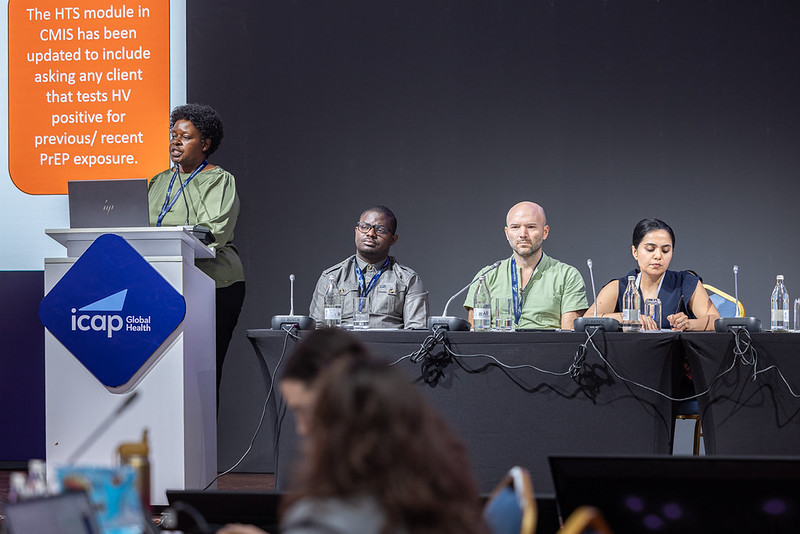
The conversation continued at the HIVE network meeting in Nairobi, held from April 22–24. The plenary, “Eliminating Maternal HIV: Optimizing M&E Systems in the Era of Diverse PrEP Options,” was co-moderated by Tiberi and Mukome Nyamuhagata of Tanzania’s Ministry of Health, with Sachathep and Sindy Matse from MOH Eswatini joining the panel. Sachathep presented an updated, proposed M&E framework for the network. This framework includes standardized indicators with defined numerators, denominators, data sources, and disaggregations across four domains: PrEP cascade, HIV testing and follow-up, maternal and pregnancy outcomes, and quality and systems.
Matse shared Eswatini’s experience building an electronic M&E system for PrEP among pregnant and breastfeeding women, including practices that had strengthened the program – an opt-out approach to PrEP, embedding indicators into antenatal and postnatal modules, and using unique client identifiers that link data across the maternal-child continuum.
The CoP is reconvening this June to continue its work on strengthening M&E systems for HIV prevention among pregnant and breastfeeding women, with the next session focused on data and metrics for oral and long-acting PrEP.
In the meantime, the recording and presentations from the February meeting are available here.