

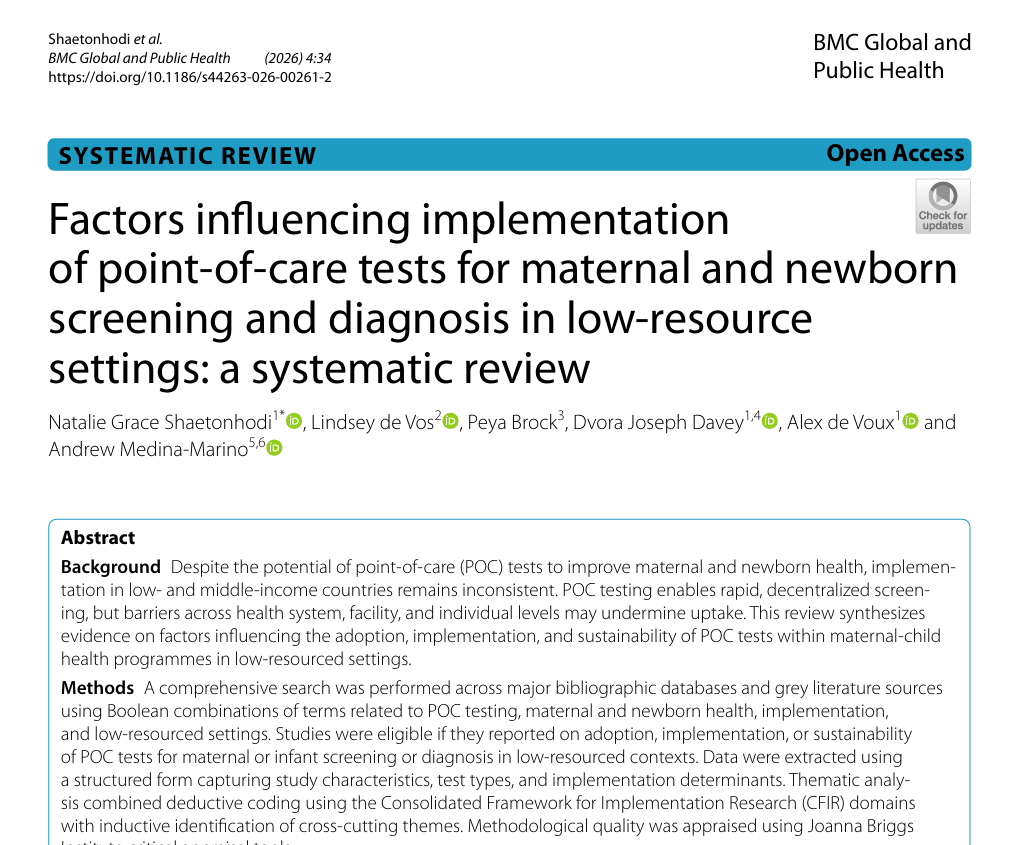
Factors influencing implementation of point-of-care tests for maternal and newborn screening and diagnosis in low-resource settings: a systematic review
This review synthesizes evidence on factors influencing the adoption, implementation, and sustainability of POC tests within maternal-child health programmes in low-resourced settings. Key facilitators of implementation included rapid turnaround time, portability, ease of use, perceived clinical benefit, supportive policy environments, and compatibility with existing workflows. Task-shifting, bundled testing, and integration with routine maternal-child health services supported sustainability. However, common barriers included weak supply chains, vertical funding, limited political will, training gaps, workforce shortages, and fragmented programme delivery. Sociocultural barriers, such as stigma and limited decision-making power among pregnant women, also constrained uptake.
Resource Details
- Study Type
- Review
- Year
- 2026
- Population
- Breastfeeding Women, Pregnant Women
- Author
- Shaetonhodi NG, de Vos L, Brock P, Davey DJ, de Voux A, Medina-Marino A.
- Source
- BMC Global Public Health
More Publications & Resources
PrEP including LEN Counselling Guide for PBFP
LEN Learning Clinic 2: Clinical Considerations for the Implementation of LEN
Kenya Integrated Guidelines for Prevention, Treatment and Management of HIV, Sexually Transmitted Infections and Viral Hepatitis, 2026
Providing PrEP to Pregnant and Breastfeeding Women
Clinical Practice Guidelines for Providing PrEP for Pregnant and Breastfeeding Populations
Guidelines on Lenacapavir for HIV Prevention and Testing Strategies for Long-Acting Injectable Pre-Exposure Prophylaxis
PrEP and PEP Guidelines-Zambia
PrEP Lenacapavir Implementation Guidelines
Provider Training Toolkit on Use of Oral and Long-acting HIV PrEP: Lenacapavir-Focused Learning Pathway (Lessons 1-4)
Provider Training Toolkit on Use of Oral and Long Acting HIV PrEP
Inclusion of Pregnant and Lactating People in the PURPOSE 1 Study: Efficacy, Safety, and Pharmacokinetics
No results found.