

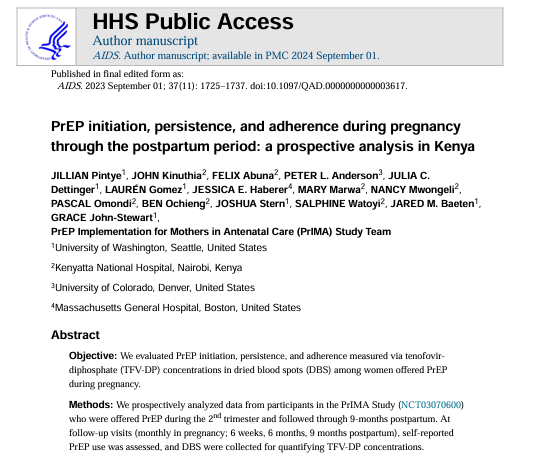
PrEP initiation, persistence, and adherence during pregnancy through the postpartum period: a prospective analysis in Kenya
Participants were offered PrEP during their 2nd trimester and followed through 9-months postpartum. At the end of the study, 58% of PrEP initiators self-reported persistence of use, and 50% of randomly selected DBS had quanitfiable TFV-DP. Having quantifiable TFV-DP was twice as likely during pregnancy than postpartum, and having a partner known to be living with HIV was the strongest predictor of PrEP initiation, persistence, and quantifiable TFV-DP.
Resource Details
- Study Type
- Observational study
- Year
- 2023
- Population
- HIV-uninfected women, Pregnant Women
- Author
- Pintye J, Kinuthia J, Abuna F, Anderson PL, Dettinger JC, Gomez L, Haberer JE, Marwa MM, Ngumbau N, Omondi P, Odhiambo B, Stern J, Watoyi S, Baeten JM, John-Stewart G.
More Publications & Resources
PrEP and PEP Guidelines-Zambia
PrEP Lenacapavir Implementation Guidelines
Provider Training Toolkit on Use of Oral and Long-acting HIV PrEP: Lenacapavir-Focused Learning Pathway (Lessons 1-4)
Provider Training Toolkit on Use of Oral and Long Acting HIV PrEP
Inclusion of Pregnant and Lactating People in the PURPOSE 1 Study: Efficacy, Safety, and Pharmacokinetics
Lenacapavir Provider Tools and Job Aids
PrEP Drug Interactions
Zambia PrEP Training Materials for Clinicians and Community Mobilisers
HIV Prevention Ambassador Training Package and Toolkit
Zambia Consolidated Guidelines for Treatment and Prevention of HIV Infection
National Guidelines for the Management of HIV and AIDS
No results found.