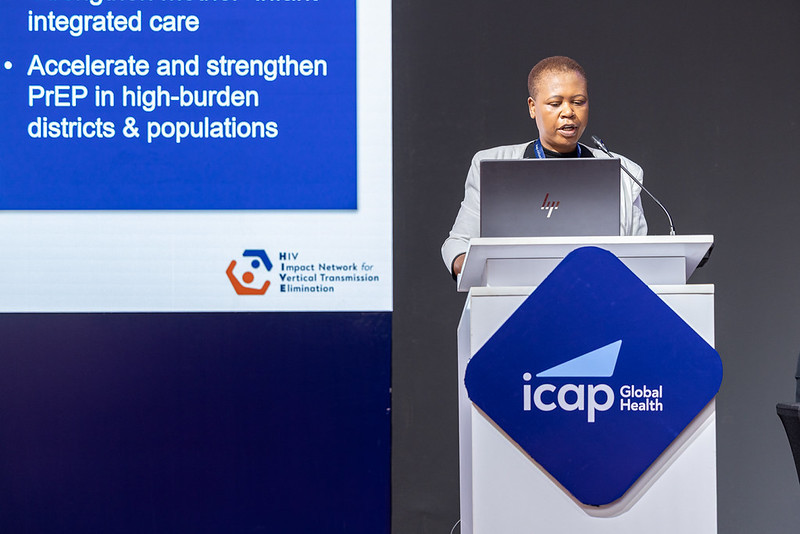
Kulani Khosa is South Africa’s national vertical transmission prevention (VTP) manager at the National Department of Health and a nurse and midwife by profession.
We spoke with her about South Africa’s priorities for preventing vertical transmission, progress in expanding PrEP for pregnant and breastfeeding women, persistent implementation and data gaps, and what the country is learning through the HIVE network.
What are some of South Africa’s top priorities for preventing vertical transmission right now?
Our priorities are closely linked to the Global Alliance to End AIDS in Children and South Africa’s Path to Elimination work. We are not only focusing on HIV; the country is pursuing the path to triple elimination of HIV, syphilis, and hepatitis.
Another priority is strengthening implementation across the VTP program, including the first 1,000 days mother–infant pair package and building the capacity of health care providers to implement the revised guidelines.
South Africa has been expanding PrEP for pregnant and breastfeeding women. What progress are you seeing, and where is more work needed?
We integrated PrEP into antenatal and postnatal services as part of the VTP program. PrEP is delivered alongside other maternal, child, and women’s health services, including family planning and sexual and reproductive health services, STI screening and treatment, and partner testing.
We have seen progress in uptake. In 2025, among antenatal clients who tested HIV-negative, the number of women initiating PrEP increased from 18% in the first quarter to 30% in the third and fourth quarters.
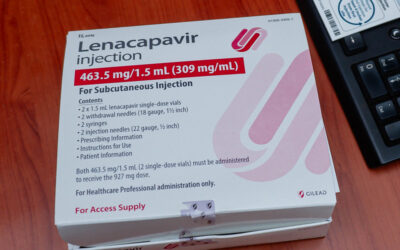
But continuation still needs attention, particularly during the postpartum period. We are focusing on strengthening integrated mother–infant care and expanding prevention options, including lenacapavir.
Where do you see some of the greatest gaps in sustaining VTP gains?
I think one of the main gaps is implementation, particularly training and capacity building. When we train on HIV-related issues, the focus is often on HIV staff, and we can forget the midwives who are working in the maternal and child health stream. It can then look like they do not know how to implement the guidelines, when the issue is that we are not capacitating or mentoring them enough.
The second issue is data. Sometimes services are being implemented, but we do not have the tools or indicators to capture everything that is happening. Services may be there, but if we don’t capture and monitor them, we cannot tell where we are.
Is there a specific learning opportunity through HIVE that could help South Africa address some of these gaps?
We are learning a lot through the network.
One area of interest is tracking mother–infant pairs over time and across facilities. We understand that Tanzania is implementing this, and we would like to learn more about how they maintain record-keeping and follow infant outcomes.
We are also interested in Mozambique’s approach to youth-friendly services for young pregnant women. In South Africa, youth and maternity services are often organized separately. We would like to learn from Mozambique how they support care continuity during that transition to keep young pregnant women connected to services.
What has HIVE helped make possible for South Africa over the past year?
HIVE has helped us focus more closely on VTP. It has opened our eyes to where our gaps are.
The CMM tool, in particular, helped us unpack different areas of the program. We could look at something and say, “Okay, we have a gap here,” and then work on it.
When I compare baseline performance from when HIVE started with where we are now, I can see progress. The provinces involved are also very receptive, and other provinces that are not currently supported are interested.
South Africa has nine provinces, and HIVE is currently supporting two, so we are excited about the possibility of expanding these interventions further.
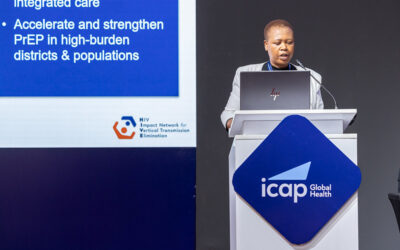
Learn more: At HIVE’s April 2026 meeting on advancing HIV prevention and PrEP for pregnant and breastfeeding women, Kulani Khosa presented additional insights from South Africa’s national program.
Explore her presentations, “Prevention in Practice: South Africa—Updates and Innovations on HIV Prevention in PBFW” and “From Risk to Results: Strengthening the VTP Cascade for Mothers and Infants in South Africa.”